
How to Calculate Dimensional Weight in 2026: UPS, FedEx and the New USPS Rules
· by Redaktion
To calculate dimensional weight, round each side of your box up to the next whole inch, multiply length x width x height, and divide by the carrier's divisor (139 for USPS on packages over one cubic foot, and for FedEx and most UPS daily rates). You are billed on whichever is higher, actual weight or dimensional weight. The fastest way to cut those charges is to ship in smaller boxes, and the fastest way to a smaller box is less void fill and a thinner, more even protective layer.
Why does dimensional weight suddenly cost you more in 2026?
Carriers do not just weigh your parcel anymore. They compare the actual weight to a calculated volume figure called dimensional weight, often shortened to dim weight, and bill you on whichever is higher. Two changes in a row have pushed that calculated number up.
First, on August 18, 2025, both UPS and FedEx started rounding every fractional inch of a package dimension up to the next whole inch. Before that, fractions under half an inch were rounded down. UPS gave the blunt example that an 11.1 inch length is now treated as 12 inches.
Then on July 12, 2026, the USPS lowered its dimensional weight divisor from 166 to 139 and adopted the same round-up rule, measuring length, width, and height in inches and rounding each one up to the nearest whole inch. The Postal Service said it made the change for consistency with industry standards. A smaller divisor means a larger billable weight: on packages over one cubic foot, the divisor change alone raises the dimensional figure by roughly 19 percent (166 divided by 139), before the extra effect of rounding.
For high volume shippers the compounding is real. One logistics provider modeled a single customer shipping 2,500 parcels a month and put the added annual cost from the rounding change alone at $32,678. That is one provider's model for one account, not an industry average, but it shows why box size now sits on the finance team's radar.
How do you calculate dimensional weight the way carriers actually do?
Here is the USPS method in effect since July 12, 2026, for rectangular packages:
- Measure length, width, and height in inches.
- Round each measurement up to the next whole inch.
- If the volume is 1,728 cubic inches (one cubic foot) or less, you are billed on actual weight only. Dimensional weight does not apply.
- If the volume is larger, multiply the rounded dimensions, divide by 139, and round up to the next whole pound.
A worked example shows how much the rounding stings. Say your carton measures 16.2 x 12.1 x 10.1 inches. Rounded up, it becomes 17 x 13 x 11 = 2,431 cubic inches. Divide by 139 and you get 17.5, billed as 18 pounds. Trim that same shipment to exactly 16 x 12 x 10 inches and the math is 1,920 cubic inches divided by 139 = 13.8, billed as 14 pounds. Four billable pounds vanished, and all you changed was a fraction of an inch on each side.
FedEx uses a divisor of 139 as standard. UPS uses 139 for daily rates and 166 for retail rates, so your contract matters: at published daily rates you pay the 139 figure, but negotiated rates can differ. Keep in mind the USPS one cubic foot threshold is a USPS rule; for FedEx and UPS, confirm how the dimensional minimum applies to your service in your current rate and service guide.
What triggers the big oversize surcharges, and how do you stay under them?
Dimensional weight is only half the story. Oversize packages also pick up flat fees that dwarf a few extra pounds.
Since January 2026, FedEx (from January 12) and UPS (from January 27) apply an additional handling surcharge by volume once a package passes 10,368 cubic inches (six cubic feet). Go past 17,280 cubic inches (ten cubic feet) or 110 pounds of actual weight and you hit the FedEx oversize charge or the UPS large package surcharge. As of January 2026, Supply Chain Dive reported FedEx additional handling at $29.50 to $40.75, UPS additional handling at $30.00 to $40.50, FedEx oversize at $255 to $330, and UPS large package at $219.50 to $286 commercial. These amounts are zone dependent and can change during the year, so verify them in the current carrier guide before you budget around them.
The USPS layers its own size based nonstandard fees on top of dimensional weight. On the price list effective October 4, 2026, Ground Advantage Commercial adds $4.50 for parcels over 22 to 30 inches long, $10.00 over 30 inches, and $21.00 over two cubic feet (3,456 cubic inches). Priority Mail adds $21.00 over 30 inches and $35.00 over two cubic feet. Note that October 4, 2026 through January 17, 2027 is also a temporary USPS peak pricing window, so treat these numbers as current and check for updates.
Analysts give two practical levers: negotiate lower surcharges where you have the volume to do it, and adjust package dimensions so you stay under the thresholds. That second lever is where packaging design earns its keep.
How do you cut the box size without risking damage?
Every tenth of an inch your padding bulges out can cost a full inch per side once the carrier rounds up, which then pushes volume, dimensional weight, and sometimes a surcharge tier. The mechanism is simple: a thinner, more even protective layer lets you drop to a smaller carton, and a smaller carton lowers the billable volume.
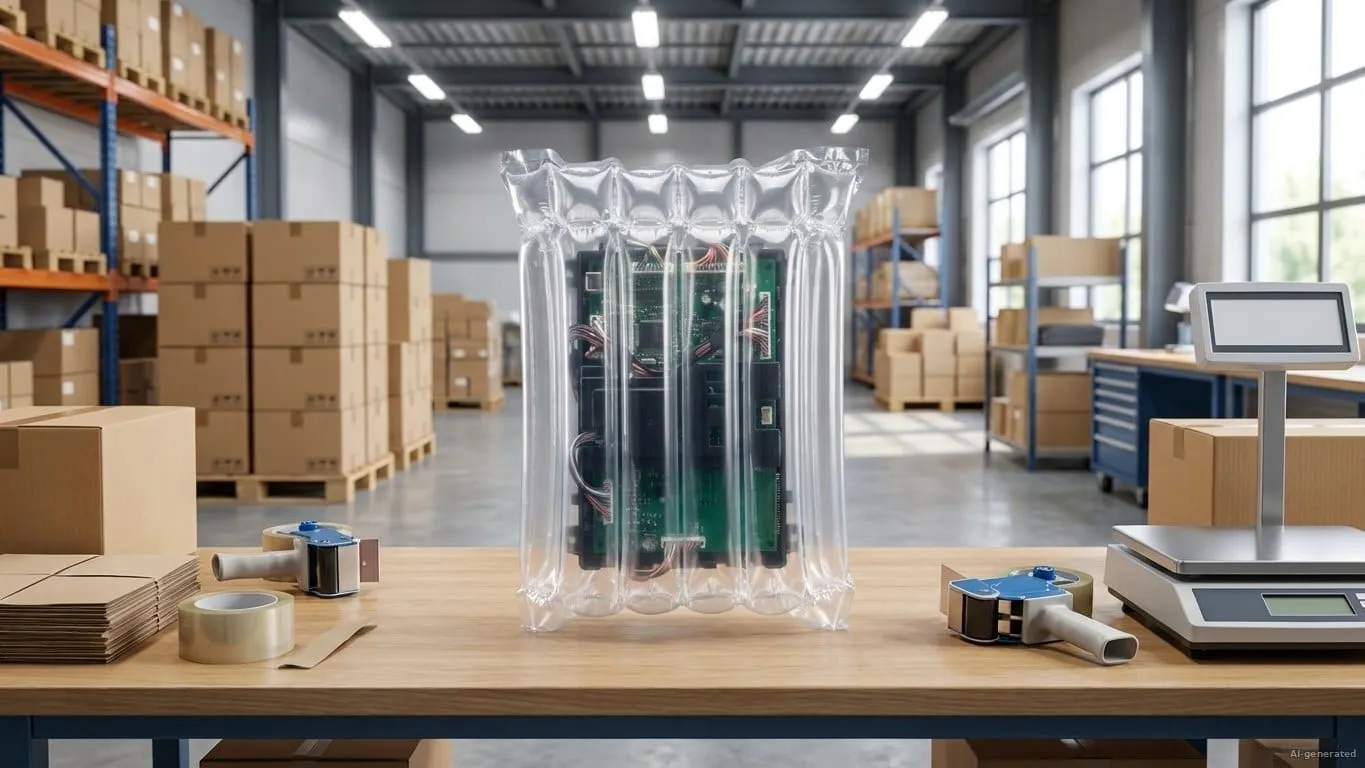
This is one place air column packaging fits as one lever among several, not a cure all. Air column packaging, also called air chamber packaging, wraps the product in inflatable chambers that are shipped and stored flat and inflated in seconds at the packing station, with no cutting and no loose void fill. Because the cushioning is thin and conforms to the product, you can often spec the next carton size down. UNIQBAG reports 360 degree air column protection and, as manufacturer data, transit damage rates on fragile goods typically dropping from 3 to 5 percent to under 0.5 percent. Those are manufacturer figures, not independent results.
Do not assume a thinner layer protects just as well on faith. Validate the new pack with a recognized transit test before you roll it out, for example ISTA 3A for parcel delivery or an ISTA 6-Amazon.com procedure if you ship into Amazon fulfillment. If you want to pressure test the approach on your own products, start with the product examples or describe your shipment on our custom solutions page.
On the material side, UNIQBAG film is a resource efficient multi-layer technology (85% LDPE + 15% nylon/PA) engineered with a protective barrier layer for maximum source reduction and fully processable through commercial plastic recovery channels. It ships flat for up to 99% less storage volume (manufacturer data).
Frequently Asked Questions
How do you calculate dimensional weight for USPS in 2026? Round each side up to the next whole inch, and if the box is larger than 1,728 cubic inches, multiply length x width x height, divide by 139, and round up to the next pound. You pay the higher of that figure or the actual weight.
What divisor do FedEx and UPS use? FedEx uses 139 as standard. UPS uses 139 for daily rates and 166 for retail rates, so check which rate set your contract falls under.
Does dimensional weight apply to small packages? At USPS it applies only to packages over one cubic foot (1,728 cubic inches); smaller parcels bill on actual weight. For FedEx and UPS, confirm the dimensional minimum for your service in the current rate and service guide.
How do I save on shipping costs quickly? Shrink the box. Reduce void fill, use a thinner and more even protective layer so you can step down a carton size, and keep dimensions under the surcharge thresholds. Then validate the new pack with a transit test like ISTA 3A.
Is there a cap on dimensional weight at USPS? Yes. If the dimensional weight exceeds 70 pounds, USPS charges the 70 pound price.
Ready to see whether a smaller, drop-test validated pack can pull your shipments under the next dimensional weight tier? Request your custom packaging solution and tell us what you ship.
Related to this article: More Packaging Solutions by FUCHSPACK MINI AIR PRO2 air cushion machine and PaperEZ Bubble paper cushioning — additional packaging solutions offered alongside the UNIQBAG system. More about More Packaging Solutions by FUCHSPACK →
Quellen
- USPS Federal Register notice: DIM factor 139 and rounding (Doc. 2026-09785)
- USPS Domestic Mail Manual 223, Section 1.4 Dimensional Weight
- USPS Notice 123 Price List (effective October 4, 2026)
- USPS to align dimensional pricing closer to FedEx, UPS (Supply Chain Dive)
- FedEx, UPS tweaks could spur more large package fees (Supply Chain Dive)
- UPS matches FedEx with dimensional weight change (Supply Chain Dive)
- ISTA Test Procedures
Transparency note: This article was created with AI assistance and reviewed by our editorial team. The article image is AI-generated.