
Drop-Test Standards Explained: ISTA 3A, ISTA 6 and What Your Parcel Goes Through
· by Redaktion
A drop test shows how your packaging is likely to hold up in transit before your customers find out. ISTA 3A is the general-simulation drop test for single parcels up to 150 lb, and ISTA 6-Amazon.com-SIOC is the Amazon protocol behind Ships in Own Container certification; for non-fragile rigid packages under 50 lb, Amazon also accepts a vendor-run drop test. Both subject your package to a fixed sequence of drops and vibration, and the Amazon protocol adds compression and clamp tests at 50 lb and up, so you learn where it fails in the lab instead of in transit.
What Is a Drop Test and How Is Packaging Actually Tested?
A drop test is one part of a larger laboratory simulation that reproduces the shocks, vibration and forces that damage products in a real distribution system. The International Safe Transit Association groups its procedures by how closely they imitate the real world: 1-Series integrity tests with no simulation, 3-Series general simulation, and 6-Series Member Performance Tests for specific retailers.
ISTA 3A sits in the general-simulation 3-Series and covers single-parcel shipment, by air or ground, for packages weighing 150 lb (70 kg) or less. It defines four package types, Standard, Small, Flat and Elongated, each with its own sequence. For a Standard package the core sequence runs: preconditioning, nine drops at a weight-dependent height, random vibration with and without a top load, then eight more drops including a drop onto a hazard. Liquids also get an eight-hour leak test.
Crucially, ISTA does not define "pass" for you. The shipper decides beforehand what counts as product damage and what package condition is acceptable, so a claim that a package "passed ISTA 3A" means little without those criteria. ISTA also treats product and package as one unit, with samples that should be actual, untested production items.
How Does ISTA 6-Amazon.com Differ, and When Do You Need It?
ISTA developed the ISTA 6-Amazon.com-SIOC protocol with Amazon for packages a vendor ships into a fulfillment center that then reach the customer with no extra Amazon box. If you sell to Amazon and want your item to qualify as Ships in Own Container, this is the drop-test standard that applies.
The SIOC procedure defines eight types, A through H, by shipping method, weight and product category. Type A covers parcels under 50 lb and runs much like ISTA 3A. From Type B (50 lb and up) it adds tip-over, clamp-truck simulation and one hour of vertical compression, because heavier packages face forces a drop sequence alone will not reveal.
Sample counts differ too. ISTA 3A requires one sample and recommends more for fragile or liquid products; SIOC requires five samples for fragile items, and every one must pass. Since June 1, 2021, Amazon lets vendors run the drop sequence themselves for non-fragile ASINs under 50 lb, while fragile ASINs and anything 50 lb or heavier still need the full SIOC test. A product counts as fragile when 50 percent or more of its parts are glass, ceramic, porcelain, clay or liquid.
Why Do Packages Fail These Tests?
Amazon has published the most common failure modes for SIOC packaging, and they are rarely exotic. Open or loosely tucked flaps top the list: flaps not securely adhered along their full length do not survive the sequence. Other frequent failures include overhangs such as handles or hangers, cartons that deform under hand pressure, carton rupture or puncture, and packaging that is not six-sided. For weak cartons, Amazon recommends thicker or higher-grade corrugated board.
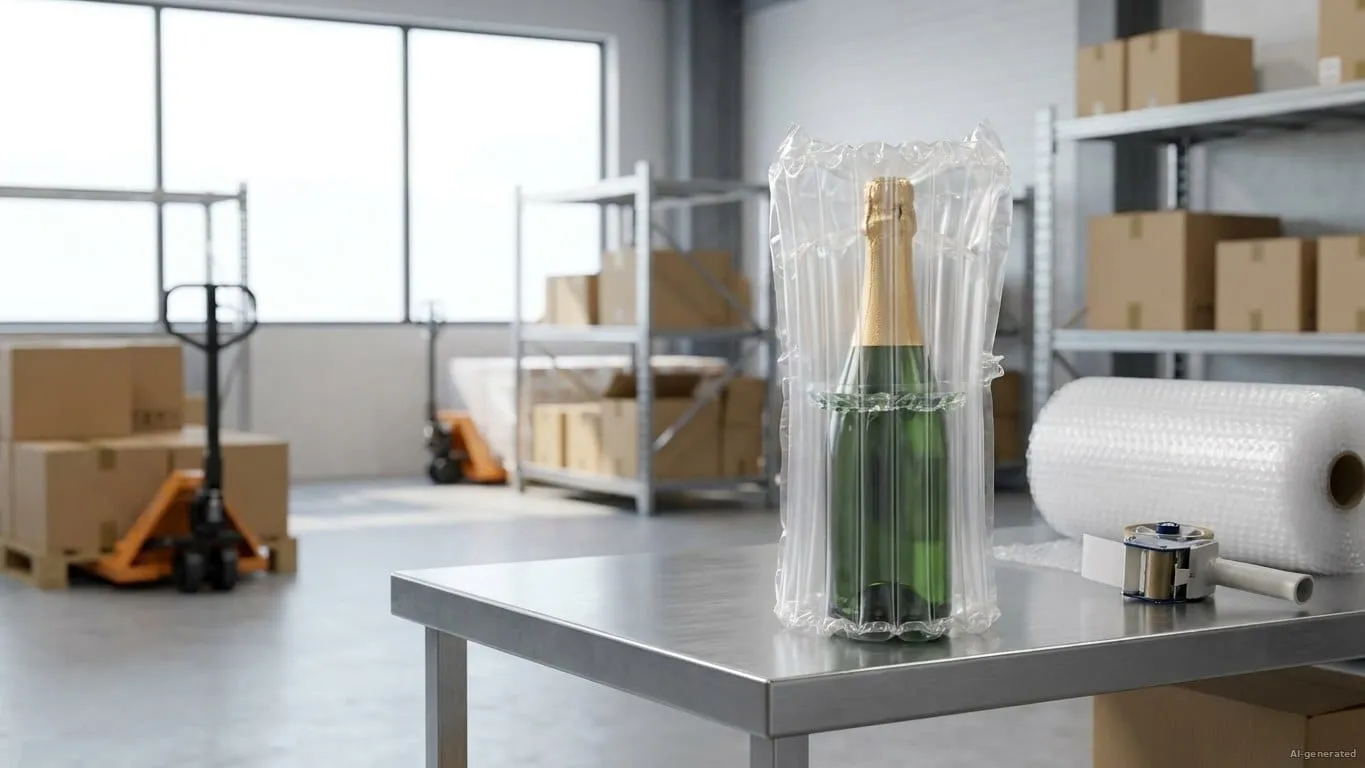
Those failure points are where engineered protection earns its place. UNIQBAG air column packaging wraps the product in inflated chambers that hold it away from the carton walls and absorb shock on every face, edge and corner, where real-world drops tend to land. Because the bags ship flat and inflate in seconds at the packing station, you add protection without loose void fill, and you can see how insert, inflate and protect works at your bench.
If your SKUs vary in size or fragility, a custom air column solution sizes the chambers to each product so it sits snugly in a right-sized carton. Air column bags, also called air chamber packaging, give you a consistent internal structure across a product line, while a six-sided outer box with fully taped flaps and no protrusions remains the job of the carton itself.
Frequently Asked Questions
How is packaging tested in a drop test? Packaging is tested as a complete unit, product plus package together, using actual untested production items. A technician runs a fixed sequence of drops onto faces, edges and corners, with random vibration and, for heavier loads, compression and clamp simulation. The shipper defines in advance what counts as damage.
Is ISTA 3A the same as the Amazon drop test? No, but Type A of ISTA 6-Amazon.com-SIOC closely mirrors ISTA 3A for parcels under 50 lb. The Amazon protocol adds requirements for heavier and oversized packages and ties into Amazon's packaging certification tiers, which require rigid packaging to be six-sided and free of protrusions.
Can I run these drop tests myself? Since June 1, 2021, Amazon allows vendors to run the drop sequence in-house for non-fragile ASINs under 50 lb. Fragile ASINs and heavier items still require the full SIOC test in an ISTA-certified lab.
Does UNIQBAG replace a drop test? No. UNIQBAG is protective packaging, not a test. It cushions the product and keeps it from shifting, which targets product damage, one of the failure modes Amazon lists. Carton strength, closure and shape still matter, and the test determines whether your product and package meet your criteria.
Want to know whether your product survives the journey? Try the system first with the UNIQBAG US Test Kit, which includes an inflation tool and 60 mixed sample bags, ordered on invoice. When you are ready to match protection to your exact SKUs, request your custom packaging solution.
Related to this article: Air Column Packaging in Action Discover UNIQBAG air column packaging in action: Secure inflatable protective packaging for laptops, wine, toner & displays. The modern alternative to bubble wrap. Reduce DIM weight & shipping costs. More about Air Column Packaging in Action →
Quellen
- ISTA 3A: Packaged-Products for Parcel Delivery System Shipment 70 kg (150 lb) or Less, Overview
- ISTA 6-Amazon.com-SIOC: Ships in Own Container, Overview
- ISTA Test Procedures Overview
- Amazon Frustration-Free Packaging Program Certification Guidelines v10.3
- FFP Incentive Expansion: Amazon-Vendor Drop Test SOP
- Frustration-Free Packaging: Common Failure Modes for Tier 1-FFP and Tier 2-SIOC
Transparency note: This article was created with AI assistance and reviewed by our editorial team. The article image is AI-generated.