
The True Returns Cost of a Damaged Shipment
· by Redaktion
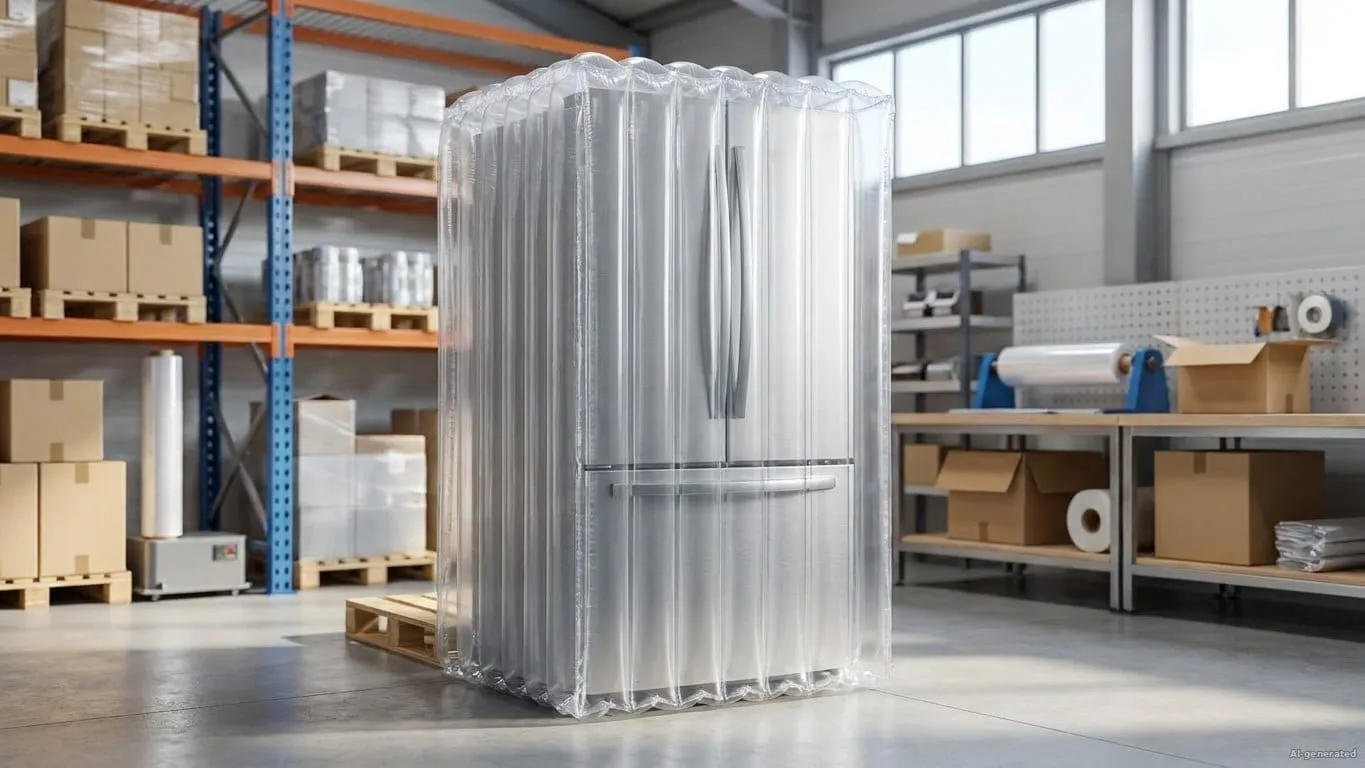
A damaged shipment rarely costs you just the price of the broken item. Once you add the return freight, the replacement order, the labor to process it all and the dent in your product reviews, the true returns cost of a single breakage can exceed the value of what you shipped. The fastest way to protect that margin is to stop the damage before it starts, at the packing station.
Returns are already a major cost factor in US retail. The National Retail Federation and Happy Returns project total US retail returns of $849.9 billion in 2025, with an estimated 19.3% of online sales sent back; that figure covers every return reason, not transit damage alone [0]. Because 82% of consumers say free returns are an important consideration when shopping online [0], passing that cost on to the customer is difficult. When a parcel arrives crushed or punctured, much of that cost often lands on you.
Why is the returns cost of a damaged shipment higher than the product value?
When one fragile item breaks in transit, the money adds up fast. The original goods are written off. You pay return freight to get the parcel back, you ship a replacement that is often expedited to keep the customer, and your team spends labor on the claim, the reship and the service ticket.
Some of those dollars are simply unrecoverable. Under USPS rules, indemnity is limited to the item's actual value when mailed and to the coverage you paid for, and consequential losses are not reimbursed [5]. So even a paid claim covers at most the item's value, and the return freight, labor and service costs stay on your side of the ledger. That is why prevention beats recovery, and why shippers of fragile, high-value goods look at air column packaging that holds the product in a cushion of pressurized air instead of loose void fill.
Corrugated boxes make the risk concrete. Peer-reviewed work on parcel handling notes that most parcels ship in corrugated board and are frequently crushed or punctured in e-commerce distribution, and that puncture-related damage can lead to product damage, customer dissatisfaction and costly returns [6]. Inflatable protective packaging, also called air chamber packaging, is designed to absorb those shocks so the box can take a hit without the contents paying for it.
Who pays for a damaged shipment, the carrier or you?
It depends on the contract, the terms and the carrier, so treat the following as background rather than legal advice and confirm your own situation. Two layers usually matter.
The first is who held the risk of loss during transit. Under the Uniform Commercial Code, a shipment contract passes the risk of loss to the buyer once the goods are duly delivered to the carrier, while a destination contract keeps it with the seller until the goods are tendered at the destination [3]. F.O.B. terms track the same split: F.O.B. shipping point moves risk at the carrier, F.O.B. destination keeps cost and risk with the seller [4].
The second layer is what you can recover. In interstate motor freight, the Carmack Amendment makes carriers liable for the actual loss or injury to the goods, but it also lets them limit liability to a value the shipper declares in writing [1]. If you never declare a higher value, you may recover only a fraction of the loss. The same statute says a carrier cannot set a claim-filing deadline shorter than 9 months or a lawsuit deadline shorter than 2 years from written claim denial [1].
Even a valid claim ties up money for months. Federal rules require a carrier to acknowledge a proper written claim within 30 days and to pay, decline or make a firm written settlement offer within 120 days [2]. For USPS shipments, either the sender or the recipient may file, no later than 60 days after the mailing date, and you must keep all packaging as evidence [5]. USPS can also deny a claim when an item was insufficiently packaged to reach its destination undamaged [5], so your packaging decision directly affects whether you recover anything.
Related to this article: Air Column Packaging in Action Discover UNIQBAG air column packaging in action: Secure inflatable protective packaging for laptops, wine, toner & displays. The modern alternative to bubble wrap. Reduce DIM weight & shipping costs. More about Air Column Packaging in Action →
How does better protective packaging lower your returns cost?
Fewer damages mean fewer replacement shipments, and that is where air column packaging earns its keep. UNIQBAG surrounds the product with 360 degree air columns that are inflated in seconds at the packing station, with no cutting and no void fill to measure out. According to manufacturer data (September 2026), transit damage rates on fragile goods typically drop from 3 to 5% to under 0.5%, pressure loss stays at a maximum of 8% over 180 days, and the flat-shipped film takes up to 99% less storage volume before it is inflated.
The film is a resource-efficient multi-layer technology, engineered with a protective barrier layer for maximum source reduction (85% LDPE and 15% nylon/PA) and fully processable through commercial plastic recovery channels. Because it ships and stores flat, it takes up far less space in your warehouse before a parcel goes out.
There is a review angle too. Research from Northwestern's Spiegel Research Center found that a product with five reviews is 270% more likely to be purchased than one with none, with purchase likelihood peaking when the average rating sits between 4.0 and 4.7 stars [7]. The study does not measure damage specifically, so no causal claim is made here; still, every breakage you prevent is one fewer reason for a one-star note.
Frequently Asked Questions
What is the true returns cost of a damaged shipment?
It is the stacked total of the written-off goods, the return freight, the replacement order, the labor to process the claim and reship, and the reputational hit, not just the item's price. Under USPS rules, a paid claim covers at most the item's actual value when mailed, up to the coverage purchased, and consequential losses such as lost profit are not reimbursed [5].
Who is liable when a parcel is damaged in transit?
It depends on your contract and terms. The UCC determines whether the risk of loss sat with the buyer or the seller during transit [3], and in interstate motor freight the Carmack Amendment makes carriers liable for the actual loss while letting them limit that liability to a declared value [1]. This is general information, not legal advice; confirm your specific terms.
How long do I have to file a carrier claim?
For interstate motor carriers, the filing window cannot be shorter than 9 months, and the lawsuit window cannot be shorter than 2 years from written denial [1]. For USPS, file no later than 60 days after the mailing date and keep all packaging as evidence [5].
How do I test whether air column packaging fits my products?
Order a test kit and run your own drops. The US test kit includes an inflation tool and 60 mixed sample bags, so you can try the system on your actual SKUs before you switch a line over.
Your next step
Stop paying the full returns cost of breakage you can prevent. Request a custom air column packaging solution for your products, or order the UNIQBAG test kit and run your own drop tests on your actual products.
Quellen
- 2025 Retail Returns Landscape, National Retail Federation and Happy Returns
- 49 U.S.C. 14706, Carmack Amendment (Liability of carriers), Legal Information Institute, Cornell
- 49 CFR Part 370, Loss and damage claim procedures, Legal Information Institute, Cornell
- Uniform Commercial Code 2-509, Risk of Loss, Legal Information Institute, Cornell
- Uniform Commercial Code 2-319, F.O.B. and F.A.S. Terms, Legal Information Institute, Cornell
- Domestic Mail Manual 609, Filing Indemnity Claims, United States Postal Service
- Applied design of corrugated board properties (Holmvall and Holmgren), BioResources 20(3), 2025
- How Online Reviews Influence Sales, Spiegel Research Center, Northwestern University
Transparency note: This article was created with AI assistance and reviewed by our editorial team. The article image is AI-generated.