
Shipping Wine, Spirits and Glass Bottles: How to Prevent Breakage in Transit
· by Redaktion
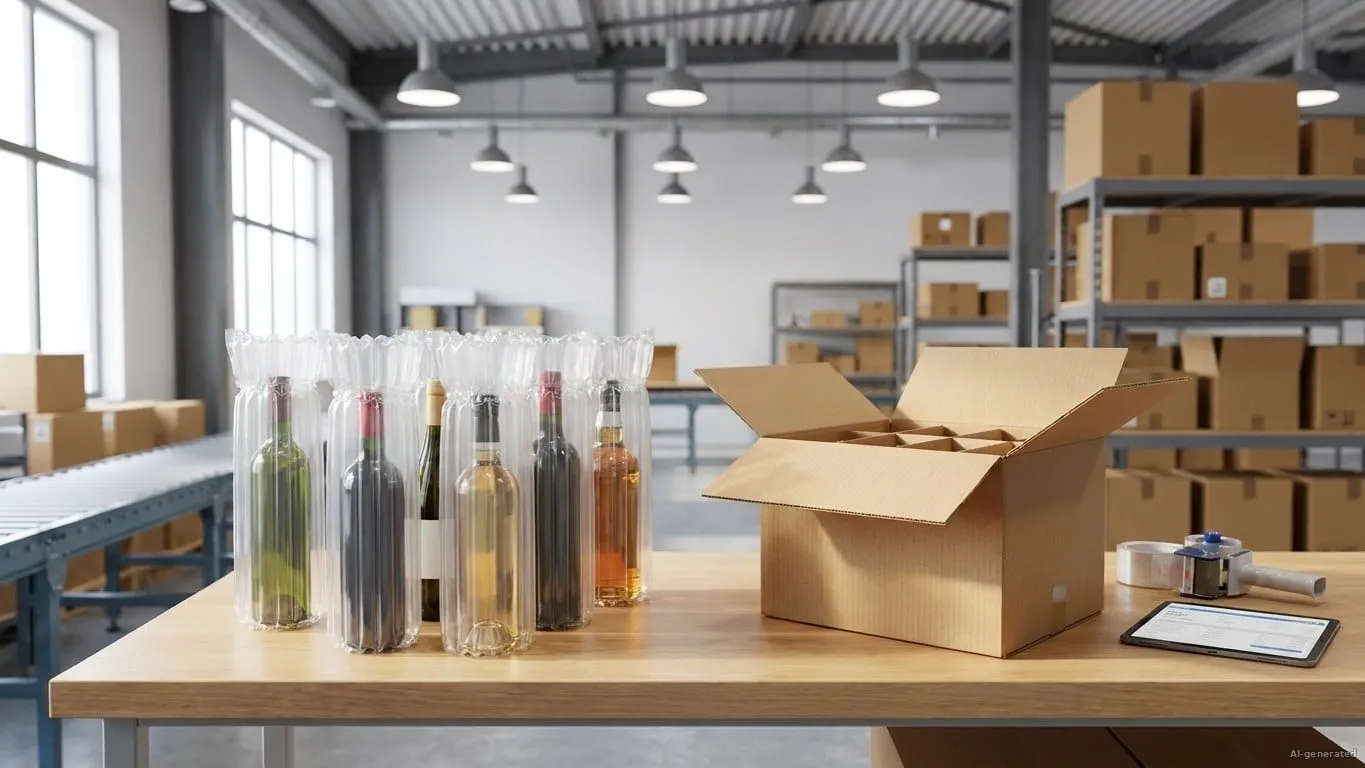
You can ship wine, spirits, and glass bottles safely, but only if the packaging does the work. UPS, for example, accepts wine only from licensed shippers with a signed UPS wine agreement, each bottle has to be locked in the center of a sturdy corrugated box away from the walls, and breakage protection has to come from cushioning, not a "Fragile" sticker. For general glass shipments, air column packaging is one way to build that center-of-box protection; for wine shipped via UPS, use one of the carrier's accepted inner packs, because air column bags are not on UPS's list.
Why do glass bottles break in transit, and what actually stops it?
Shipping is rougher than most senders assume. In a peer-reviewed field study of 5-gallon pails sent through the FedEx Ground network, roughly 28% of parcel impacts hit the box edges and 16% hit corners (Singh et al., 2009). Those figures come from instrumented pails, not bottles, so read them as a rough sense of where parcels take hits, not as breakage data for glass. The same study found that "Fragile" labels had no measurable effect on handling or drop heights. The takeaway is blunt: edge and corner protection is where fragile goods survive or shatter, and a sticker will not save a bottle.
So the protection has to be engineered into the box. For fragile goods, UPS recommends the box-in-box method: an outer carton about 6 inches larger in each dimension than the inner box, with roughly 3 inches of cushioning around the inner box and at least 2 inches between items and every wall, corner, top, and bottom. Each item should be wrapped individually and positioned toward the center.
Also called air chamber packaging or inflatable cushion packaging, air column packaging surrounds an item with individual pressurized air cells so the contents are suspended away from the walls where most impacts land. According to manufacturer data (September 2026), air column protection typically brings transit damage rates on fragile goods down from 3–5% to under 0.5%. That is a manufacturer figure with no independent data specific to wine or glass, so treat it as a vendor claim, not a tested result for bottles.
How do you pack glass bottles so they survive shipping?
Start from the carrier's own rules, because for wine they are not optional. UPS accepts only specific inner packaging for wine: molded expanded polystyrene (EPS) foam, folded corrugated trays, molded fiber trays with dividers, or thermoformed plastic trays, always inside a sturdy corrugated outer box. Air column bags are not on this list, so licensed wine shippers should not substitute them without written confirmation from their carrier. The job of any inner pack is the same: hold each bottle in the center of the box, away from the walls.
A few practical rules carry over to any glass bottle, wine or not:
- Put each sealed bottle inside a plastic or leak-proof bag so a single break does not soak and weaken the carton. UPS recommends this for bottles and containers.
- Cushion to the carrier's minimums: at least 2 inches on all sides, and the box-in-box method for anything truly fragile.
- Match the box to the weight: UPS lists 200 psi burst (or 32 lbs/in edge crush) for packages up to 30 lbs and 250 psi (or 44 lbs/in) for 31 to 50 lbs.
- Test the finished pack. UPS calls its box-strength table a guideline and recommends testing to ISTA Procedure 3A, the simulation test for individual parcels shipped by air or ground.
One honest caveat: UPS lists inflatable packaging (air bags) mainly as void fill for lighter items and warns that extreme heat or cold can reduce their performance, so glass is not an automatic case for loose air pillows. Structured air column bags are designed differently: they are sized to wrap and hold the bottle rather than fill empty space. They are still inflatable packaging, though, so the same temperature caveat applies, and there is no independent test data for wine or glass. Test your finished pack, ideally to ISTA Procedure 3A, before you rely on it. For unusual shapes or weights, a custom-engineered solution is safer than improvising.
Related to this article: Air Column Packaging in Action Discover UNIQBAG air column packaging in action: Secure inflatable protective packaging for laptops, wine, toner & displays. The modern alternative to bubble wrap. Reduce DIM weight & shipping costs. More about Air Column Packaging in Action →
What are the legal rules for shipping wine and spirits in the US?
Wine, beer, and spirits are nonmailable through the US Postal Service: the ban sits in federal law at 18 U.S.C. 1716(f) and applies to everyone, including private individuals and gifts. USPS points to that same statute, and even advertising that solicits mailing alcohol is nonmailable.
Under the 49 CFR 173.150(d) exception, wine and distilled spirits shipped by motor vehicle, rail, or vessel are not subject to US hazardous-materials rules if they contain 24% alcohol by volume or less, or if they are in inner packagings of 5 liters or less (Packing Group III beverages also qualify in packagings of up to 250 liters). By air cargo, the exception covers beverages up to 24% alcohol and those above 24% up to 70% in inner packagings of 5 liters or less. Spirits above 70% alcohol do not qualify for the air exception, so do not treat them as ordinary air parcels. Carrier alcohol policies apply on top of these federal rules.
Private carriers are tightly controlled. UPS transports wine only for shippers who are licensed under applicable law and have signed a UPS wine shipping agreement; shipments from anyone without one are not accepted. Wine packages require a special alcohol shipping label and delivery with an adult signature from someone 21 or older.
Whether a winery may ship direct to consumers in another state is decided by the destination state. According to the Wine Institute's direct shipping table (last updated May 2025), 41 states allowed direct-to-consumer wine shipping, 7 allowed it with restrictions, and 2 (Delaware and Utah) prohibited it. Delaware has since enacted a narrow direct shipper law (HB 187) that took effect on August 15, 2026, with strict eligibility, volume, and delivery requirements, and carrier availability there may be limited. These figures are informational, not legal advice, and state rules change, so confirm licensing, state permissions, volume limits, and taxes with the relevant state authorities or legal counsel before you ship.
Frequently Asked Questions
Can I ship wine through USPS? No. All wine, beer, and spirits are nonmailable under federal law (18 U.S.C. 1716), including shipments by private individuals and gifts.
How do you ship glass bottles so they do not break? Seal each bottle in a leak-proof bag, suspend it in the center of a sturdy corrugated box with at least 2 inches of cushioning on every side, and use the box-in-box method. For wine, UPS accepts molded foam, fiber, or plastic trays as long as the bottle sits away from the walls.
Do "Fragile" labels protect my shipment? Not on their own. A peer-reviewed study found precautionary labels had no measurable effect on handling or drop heights. The required alcohol shipping label is still mandatory, but breakage protection has to come from the packaging.
Is air column packaging a good fit for bottles? For general glass shipments it can help, because it suspends the item in air cells away from the box walls. Manufacturer data suggests lower damage rates, but there is no independent testing specific to wine or glass, and air column bags are not on UPS's accepted inner-packaging list for wine, so verify acceptance with your carrier before using them for licensed wine shipments.
Do I need a license to ship wine? To use UPS, yes: you need a licensed shipper account and a UPS wine agreement, and the destination state's rules apply.
Ready to protect your fragile shipments?
If breakage is costing you replacements and refunds, stop relying on stickers and start engineering the box. Tell us about your product and shipping lane, and we will design a fitted air column solution for your glass and fragile goods. Request your custom packaging solution, or try the system first with the US Test Kit ($195, including an inflation tool and 60 mixed sample bags) at /order-test-kit. For more shipping-protection guides, see the UNIQBAG blog.
Quellen
- 18 U.S. Code § 1716, Injurious articles as nonmailable (Legal Information Institute, Cornell Law School)
- Publication 52, Section 424, Nonmailable Intoxicating Liquors (USPS)
- 49 CFR 173.150(d), Exceptions for alcoholic beverages (U.S. GPO, 2024)
- How To Ship Wine (UPS)
- Packaging Guidelines (UPS)
- Measurement and Analysis of Shocks to Products Packaged in Pails (Singh et al., Packaging Technology and Science, 2009)
- Test Procedures (International Safe Transit Association)
- Direct Shipping Table (Wine Institute, May 2025)
Transparency note: This article was created with AI assistance and reviewed by our editorial team. The article image is AI-generated.